Rooftop vs Ground-Mounted vs Captive Solar: Which Is Right for Your Industry?

WhatsApp Image 2026-10-28 at 2.15.23 PM

Rooftop vs Ground-Mounted vs Captive Solar: Which Model Is Right for Your Industry?

Your factory pays for power every single day. The only question is whether that money keeps leaving your business or starts working for it.


Industrial electricity tariffs rarely go down. That is why more manufacturers, warehouses and processing units are moving to solar. But the first decision is not about panels. It is about the model. Should you go rooftop, ground-mounted or captive? The wrong choice can cost you years of savings. This guide explains each option in plain terms so you can choose with confidence.

First, a Quick Clarification

These three terms are often compared as if they were the same thing. They are not.

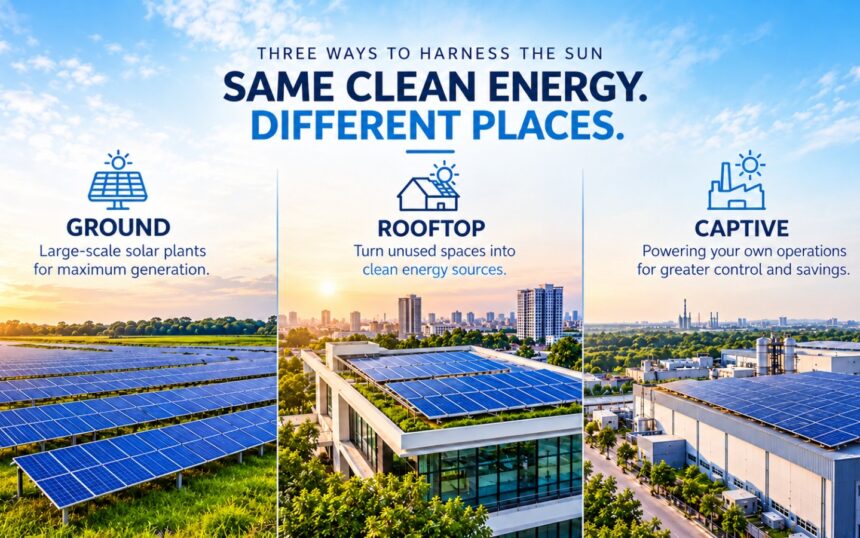
  1. Rooftop and ground-mounted describe where the panels are installed.
  2. Captive describes who owns the plant and who uses the power.

So a captive plant can be built on a roof or on the ground. Once you see this, the decision becomes much easier. You are really choosing two things: the installation type and the ownership model.

Rooftop Solar for Industry

Rooftop solar uses the unused roof space of your factory, warehouse or office building. The power is used on site, so there are no transmission losses and no extra land is needed.


Best for:

  1. Plants with large, strong, shadow-free roofs
  2. Units with steady daytime power use
  3. Businesses that want a quick start with low land needs

Advantages:

  1. Uses space you already own
  2. Faster installation than most ground plants
  3. Lower civil work and land cost
  4. Power is generated right where it is used

Limitations:

  1. Capacity is limited by roof area and load-bearing strength
  2. Shading from tanks, chimneys or nearby buildings can reduce output
  3. Older roofs may need repair or reinforcement first

As a rough guide, one kilowatt of solar needs about 100 square feet of shadow-free roof. A large industrial shed can host a meaningful system, but a compact plant may not have enough space to meet its full demand.

Ground-Mounted Solar for Industry

Ground-mounted solar is built on open land, either inside your premises or on a nearby plot. It suits businesses that need more power than their roof can produce.


Best for:

  1. Energy-intensive industries such as textiles, chemicals, cold storage and heavy manufacturing
  2. Companies with spare land
  3. Plants planning future expansion

Advantages:

  1. Not limited by roof size
  2. Panels can be tilted and placed for the best sunlight
  3. Easier cleaning and maintenance access
  4. Simple to scale up later

Limitations:

  1. Needs land, which can be costly or hard to find
  2. Higher civil and structural costs
  3. If the plot is off site, power must travel to your plant through the grid

Many projects need roughly four to five acres per megawatt, so land availability often decides this option.

Captive Solar: The Ownership Model That Changes the Economics

Captive solar means the plant is set up mainly to supply power to its owner or a group of owners. There are two common forms.


Individual captive. You own 100 percent of the plant and consume the power directly. You get maximum control and the highest long-term return, but you also carry the upfront investment.


Group captive. Several industrial users share ownership of one larger plant. Under the Electricity Rules, the consuming members must hold the required ownership share and use the required share of the power. This lets mid-sized units access large-scale solar at lower cost per unit, without building a plant alone.


Why industries choose captive:

  1. Lower and more predictable cost per unit than grid power
  2. Protection from future tariff hikes
  3. Better control over energy costs and budgeting
  4. Support for sustainability and ESG targets

Kirnoday Energy’s captive model, for example, is built around full ownership and direct self-consumption, with a levelized cost of about ₹3.5 per unit and a 25-year performance focus.

Side-by-Side Comparison

Factor

Rooftop

Ground-Mounted

Captive

What it describes

Installation location

Installation location

Ownership and usage model

Land needed

None

Yes

Depends on installation type

Typical scale

Small to medium

Medium to very large

Medium to very large

Setup speed

Fast

Moderate

Moderate

Best for

Plants with roof space

Plants with spare land

Industries wanting cost control

Main limit

Roof area

Land availability

Investment and approvals

What About Zero-Investment Options?

Not every business wants to put capital into a solar plant. In a third-party sale or PPA model, a developer builds and maintains the plant, and you buy the power at a fixed tariff for a long term. You skip the upfront cost, though your savings per unit are lower than with an owned plant. It suits companies that prefer to keep their capital in core operations.

How to Choose the Right Model

Ask these five questions:

  1. How much roof space do I have? If it covers most of your load, rooftop may be enough.
  2. Do I have land? If power needs are large and land is available, go ground-mounted.
  3. How much do I want to invest? Owning the plant gives the best return. A PPA gives the easiest start.
  4. What is my daytime load? Solar works best when you use power in daylight hours.
  5. What is my long-term plan? If you will expand, choose a design that can scale.

Many industries end up with a mix: rooftop for immediate savings, plus a captive ground-mounted plant to cover the rest of the load.

Why Engineering Quality Matters

Whichever model you choose, results depend on design, equipment and execution. A plant that is badly sized or poorly built will under-deliver for years, and the loss grows with every unit it fails to produce.

Kirnoday Energy is a Gujarat-based solar EPC and park development company working across Surat, Ahmedabad, Patan and Dholera. It handles projects from design to commissioning across captive, group captive, DISCOM sale and KUSUM models. You can explore its industrial solar solutions to see how each model works in practice.

If you are still unsure which option fits your plant, you can talk to the Kirnoday Energy team for a clear recommendation based on your load, roof and land.

Final Thoughts

There is no single best solar model. Rooftop is quick and uses space you already have. Ground-mounted gives you room to grow. Captive gives you ownership and long-term control over your energy cost. The right answer depends on your roof, your land, your budget and your load pattern.


The industries that benefit most are the ones that decide early. Every month on grid power at today’s tariff is money you do not get back. Start with your numbers, pick the model that fits, and let your plant begin paying you back.

Make a Comment

Your email address will not be published. Required field are marked*