
Solar for Surat Textile Processing Units: Cutting Power Cost Per Meter

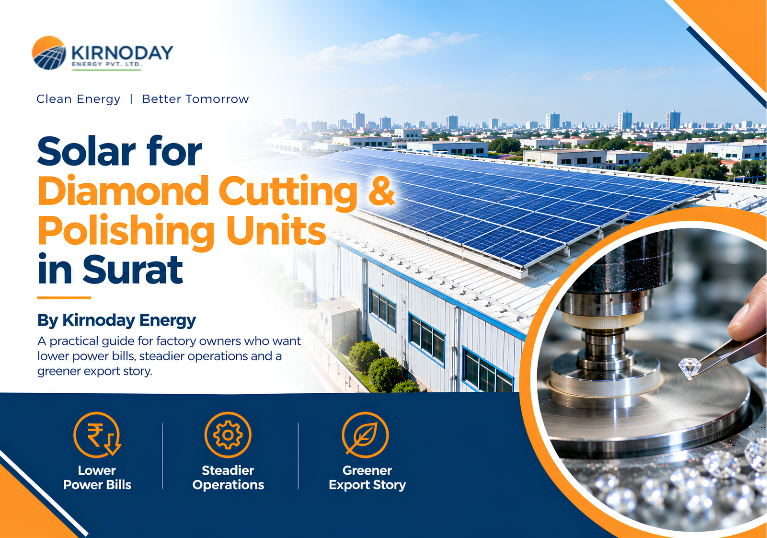
Surat cuts and polishes the vast majority of the world’s diamonds. Behind every polished stone is a factory floor running for long hours: laser cutting machines, bruting and polishing wheels (ghanti), planning and sawing equipment, air compressors, exhaust systems, air conditioning and lighting. Electricity is one of the largest recurring costs in these units, and it is also the cost owners control the least.
Rooftop solar changes that. Most diamond units operate mainly in daylight, sit in compact industrial buildings with usable roof space, and are charged industrial tariffs. That combination makes them one of the best-fit customers for commercial solar in Gujarat.
This guide explains why solar suits diamond cutting and polishing units, how the economics work, what incentives and rules apply, and how to plan an installation. To see how Kirnoday Energy supports factory owners, visit our Commercial & Industrial Solutions page.
Why Solar Fits Diamond Units So Well
- Daytime load matches solar generation. Polishing and cutting shifts run largely between morning and evening, exactly when solar panels produce the most. Little of the generated power is wasted, so self-consumption is high.
- Power quality matters. Precision work on stones is sensitive to voltage dips and trips. A well-designed solar plant with proper protection, working alongside the grid, reduces dependence on a single supply and helps keep running loads stable.
- Predictable costs. Grid tariffs and fuel surcharges change over time. Solar power, once installed, is generated at a near-fixed cost for 25 years or more, which makes margin planning easier in a business with thin and fluctuating margins.
- Roof space is available. Many units in Surat’s industrial estates have flat RCC or sheet roofs with good sun exposure and little shading, ideal for rooftop systems.
- Buyer expectations are shifting. International jewellery brands and retailers increasingly ask suppliers about responsible sourcing and emissions. Clean energy use is a credible point to add to your sustainability story.
Understanding Your Load
Before sizing a plant, collect the facts that decide its design:
- Connected load and contract demand (kW / kVA)
- Monthly units consumed (kWh) for the last 12 months
- Shift timings and any night operations
- Tariff category and the applicable demand and energy charges
- Available shadow-free roof area and roof type (RCC, metal sheet)
- Existing backup such as a DG set
A unit running polishing wheels, compressors and air conditioning for 10 to 12 hours a day typically has a strong, steady daytime base load. That is the profile solar handles best.
How Much Can You Save?
A well-sited rooftop plant in Surat can generally be expected to produce roughly 1,300 to 1,500 units per kW of installed capacity each year, depending on design, tilt, shading and maintenance. Savings depend on your tariff, but a simple way to estimate them is:
Annual savings = Units generated by solar × Your average cost per unit from the grid
For example, a 100 kW system generating around 1.3 to 1.4 lakh units a year can offset a meaningful share of a medium-sized unit’s consumption. Commercial and industrial systems often pay back within a few years and keep producing for 25 years or more. These figures are indicative. Your own payback depends on system cost, tariff and usage, so ask for a site-specific calculation.
Incentives, Policy and Rules to Know
Government and state schemes change from time to time, so always confirm current terms before you sign. The main reference points are:
- Accelerated depreciation: Businesses installing solar have historically been able to claim accelerated depreciation under the Income Tax Act. Confirm the current rate with your chartered accountant.
- Net metering / grid-connected rooftop policy: Gujarat has an established framework for grid-connected rooftop solar. The state agency Gujarat Energy Development Agency (GEDA) publishes policies and empanelment details.
- Central policy and updates: The Ministry of New and Renewable Energy (MNRE) is the nodal body for national solar programmes. Note that the central subsidy under PM Surya Ghar is aimed at residential households, so industrial units should not assume they qualify.
- Local distribution company: Grid connection and net metering approvals run through your utility, such as Torrent Power in Surat city or DGVCL in surrounding areas, depending on your location.
- Industry support: The Gem & Jewellery Export Promotion Council (GJEPC) is a useful resource on export-sector developments and sustainability expectations.
Approvals and paperwork can feel heavy for a factory owner. At Kirnoday Energy, our Documentation Support and Statutory Approvals services handle applications, permits and clearances for you.
Choosing a System Model
Captive Solar (CAPEX). You invest upfront, own the plant, claim depreciation and enjoy the full savings. Best when you have capital and long-term premises.
Zero Upfront PPA (OPEX). The solar developer builds, owns, operates and maintains the plant, and you buy the electricity it generates at an agreed tariff. Best when you want to go solar without any capital investment, with predictable energy pricing and no maintenance responsibility.
Group Captive Solar. Several businesses participate in one shared solar project and receive power in proportion to their ownership stake. Best for units that want the benefits of ownership with a lower individual investment.
Not sure which model suits your unit? Our team can compare all three against your tariff and usage. Explore our Solar Finance Models or contact us.
Technical Points Specific to Diamond Units
- Roof strength: Check that the roof can carry the added panel load, and plan walkways and safe access.
- Dust and cleaning: Surat’s industrial areas see dust and humidity. Plan regular panel cleaning, since soiling lowers output.
- Protection and surge handling: Use quality inverters, proper earthing and lightning protection to guard sensitive machinery.
- Shading management: Water tanks, parapets, exhaust stacks and neighbouring buildings can cast shade. A proper shadow analysis avoids disappointment.
- Monitoring: Remote monitoring lets you track generation daily and catch faults quickly.
- Grid-tied design: Units with a heavy daytime load usually do well with a grid-tied system, which is simpler than a design that needs extra equipment.
Step-by-Step: From Enquiry to Commissioning
- Collect your last 12 electricity bills and note your connected load.
- Site viability study covering roof area, orientation, shading, structure and energy usage.
- System design and engineering with expected generation, cost and payback.
- Compare proposals on panel and inverter brand, warranty, structure quality and after-sales support, not price alone.
- Documentation and statutory approvals with the utility and relevant agencies, managed by your solar partner.
- Installation and commissioning by a qualified team.
- Performance testing and quality checks before handover.
- Monitoring and maintenance through the year.
Common Mistakes to Avoid
- Choosing the cheapest quote without checking component quality and warranty.
- Oversizing the plant beyond what daytime load can use.
- Ignoring shading and roof condition.
- Skipping a maintenance contract.
- Not checking the latest policy and tax position before committing
Frequently Asked Questions
Will solar run my whole factory?
Usually it offsets a large part of daytime consumption rather than 100% of the bill. Night load still comes from the grid.
What happens during a power cut?
Standard grid-tied systems shut down during a grid outage for safety.
How long do panels last?
Quality panels typically carry performance warranties of 25 years or more, with gradual output decline over time.
How much maintenance is needed?
Mainly periodic cleaning, inspection of connections and inverter checks. Kirnoday’s monitoring and maintenance service takes care of this.
Can I go solar without investing money?
Yes. Under a Zero Upfront PPA, the developer invests in the plant and you pay only for the electricity it generates, at an agreed tariff.
Is it worth it for a small unit?
Often yes. Even smaller units with steady daytime load can see good returns. A site visit will confirm.
How Kirnoday Energy Helps Diamond Units in Surat
Kirnoday Energy provides end-to-end commercial and industrial solar EPC services from our Surat office. We handle the site viability study, system design and engineering, documentation, statutory approvals, installation and commissioning, performance testing, and long-term monitoring and maintenance. We also guide you on financing: choose Captive Solar to own the plant, Zero Upfront PPA to go solar without investment, or Group Captive to share a project with other businesses.
Conclusion
For diamond cutting and polishing units in Surat, solar is not just an environmental choice but a sound business decision. Daytime-heavy operations, rising power costs and available roof space align neatly with what rooftop solar does best. The right approach is to study your load, size the plant honestly, compare quality providers and confirm current incentives before investing.
If you run a unit and want to know what solar could do for your own bills, start by gathering your last year of electricity bills, then book a site visit or call +91 97277 14404. You can also email info@kirnoday.in or visit us at 523, Kashi Corner, B/h Kashi Plaza, Majuragate, Surat – 395002.
Disclaimer: Figures, incentives and regulations in this article are indicative and may change. Please verify current policy and tax treatment with the relevant authorities and your advisors before making an investment decision.