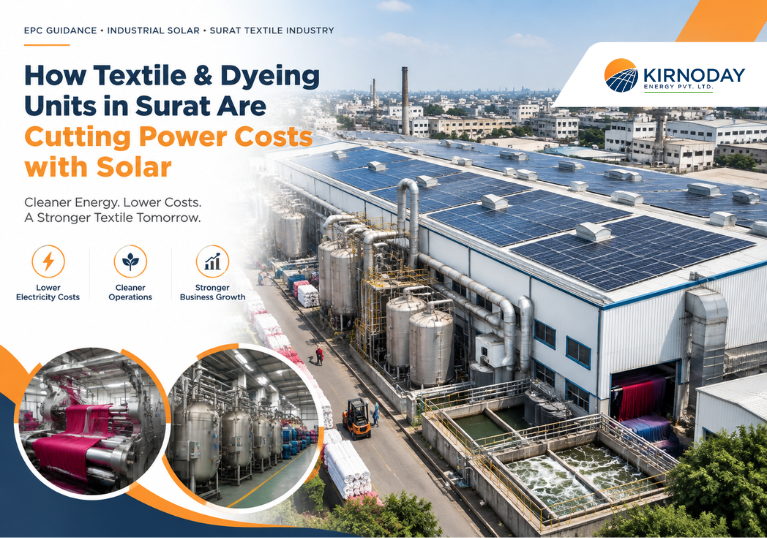
How Textile & Dyeing Units in Surat Are Cutting Power Costs with Solar

Kirnoday Blog Cover (3)

Surat runs on power. The city’s textile and dyeing units from powerloom sheds in Ved Road to processing houses in Sachin and Pandesara operate machines, dyeing vats, boilers and effluent treatment plants almost round the clock. That kind of continuous, high-volume load makes electricity one of the biggest line items on every textile unit’s balance sheet, and rising grid tariffs keep pushing that number higher every year.


The good news: textile and dyeing is one of the industries best suited to industrial solar. Predictable daytime consumption, large rooftop or shed areas, and consistent load profiles make solar not just an environmental upgrade, but a straightforward financial decision. Here’s what textile unit owners in Surat need to know before making the switch.

Why Textile & Dyeing Units Consume So Much Power

Textile manufacturing is one of the most energy-intensive segments of Indian industry, and Surat’s cluster is no exception. A single unit typically runs several load-heavy processes at once:

  1. Weaving & powerloom machines running in multiple shifts
  2. Dyeing and processing vats requiring sustained heating and pumping
  3. Boilers, compressors and effluent treatment plants (ETPs)
  4. HVAC and humidification systems for fabric quality control

Most of this load falls in daylight hours which is exactly when a solar plant generates at peak output. That overlap between consumption and generation is what makes solar economics so favourable for this sector, more so than for industries with round-the-clock or highly seasonal demand.

The Real Cost of Staying on Grid Power Alone

Industrial tariffs in Gujarat have been on a steady upward trend, and textile units being high-volume consumers feel every tariff hike directly in their cost of production. Beyond the per-unit rate, grid-only units also carry the risk of:

  1. Rising fixed and demand charges as sanctioned load increases
  2. No protection against future tariff revisions
  3. Thinner margins in an already competitive export and domestic market.

A correctly sized industrial solar plant offsets a large share of daytime grid draw, effectively locking in a big portion of your power cost for the next 25 years while the rest of the market keeps paying rising tariffs.

Rooftop or Ground-Mounted What Works for a Textile Shed?

Most textile and dyeing units in Surat operate from large single-storey sheds with expansive, uninterrupted rooftops ideal for rooftop solar. Where additional open land is available around the unit, a ground-mounted or hybrid system can be added to push capacity closer to full daytime demand. A proper site survey is essential here, since shed orientation, shading from chimneys or water tanks, and structural load capacity all affect the final design.

Our Commercial & Industrial Solutions team carries out a full feasibility study covering roof condition, shading, load profile and space availability before recommending rooftop, ground-mounted, or a combined system for your unit.

Financing Solar Without Straining Working Capital

Capital-intensive textile operations often can’t spare cash for a large upfront solar investment which is why the financing model matters as much as the technology. Depending on your unit’s size and cash-flow position, there are three practical routes:

1. Captive Solar (Full Ownership)

You own the plant outright and capture 100% of the savings, with the fastest long-term ROI typically a 3-4 year payback.

2. Zero Upfront PPA

Kirnoday designs, builds, owns and maintains the plant on your rooftop; you simply pay for the electricity generated, at a lower rate than grid tariff, with zero capital outlay.

3. Group Captive Solar

For smaller units that want ownership benefits without the full investment, a shared plant with other businesses in the cluster spreads the cost while still delivering tariff savings.

What Solar Actually Delivers for a Textile Unit

  1. Up to 40% lower electricity costs on daytime consumption
  2. 3-4 year payback period on a captive investment
  3. 25+ years of stable, tariff-protected power generation
  4. Lower cost of production a real advantage in export pricing
  5. Reduced dependency on an increasingly strained grid during peak shifts

How Kirnoday Approaches Textile & Dyeing Projects

Textile sheds bring specific engineering challenges dust, heat, vibration from machinery, and structural constraints on ageing sheds. Kirnoday’s EPC process is built to handle exactly this:

  1. Site viability study accounting for shed structure and shading
  2. Tier-1 panels and corrosion- and heat-resistant mounting structures
  3. System design synced to your actual shift-wise load pattern
  4. End-to-end handling of statutory approvals and net metering paperwork
  5. Ongoing O&M with SCADA monitoring, so output stays predictable through Surat’s humidity and dust conditions


Frequently Asked Questions

Is solar practical for a rented textile shed?

Yes a Zero Upfront PPA model works well here, since Kirnoday owns and maintains the system while you pay only for the power consumed, with no long-term asset risk on a leased property.

Will solar affect dyeing quality or production during installation?

No. Installation is scheduled and sequenced to avoid disrupting ongoing shifts, and rooftop work is carried out without interfering with production floor operations.

How much rooftop area does a typical unit need?

As a guide, 1 kW requires roughly 60 sq. ft. A site visit gives an exact figure based on your shed’s usable, shadow-free roof area.

Ready to see what solar could save your textile unit?

Kirnoday Energy offers a free, site-specific feasibility analysis for textile and dyeing units across Surat. Book a free site visit or call +91 97277 14404 to speak with our engineering team.

Explore our full range of Commercial & Industrial Solar Solutions or get in touch with any questions.

© Kirnoday Energy Pvt. Ltd. — Surat, Gujarat  |  info@kirnoday.in  |  kirnoday.in

Make a Comment

Your email address will not be published. Required field are marked*