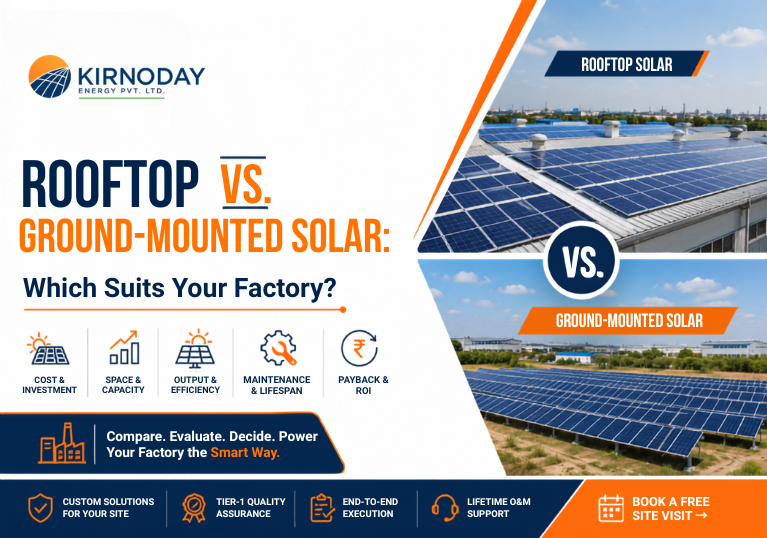
Rooftop vs. Ground-Mounted Solar: Which Suits Your Factory?
It’s one of the first questions every factory owner asks once they decide to go solar: should the panels sit on the roof, or on the ground? Both are proven, bankable technologies but the right choice depends on your plant’s roof condition, available land, load profile, and growth plans.
Here’s how the two options compare, and how to know which one fits your facility.
The Quick Answer
Rooftop solar is usually the first choice for factories with strong, well-maintained roofs and limited spare land it uses space you’re already paying for. Ground-mounted solar becomes the better option when you have open industrial land, an ageing or shaded roof, or plans to scale capacity well beyond what your roof can hold. Many large plants ultimately use a mix of both.
Rooftop Solar: Best For Space-Constrained Factories
Rooftop systems are mounted directly on factory sheds, warehouses, or office blocks making use of a surface that would otherwise sit idle.
- Lower cost per kW:- no separate land acquisition or civil foundation work required.
- Faster installation:- structures mount directly onto existing roof sheeting or RCC surfaces.
- No land-use conflict:- production and storage areas remain untouched.
- Ideal roof types:- metal sheet sheds, RCC roofs, and warehousing with large open spans
Ground-Mounted Solar: Best For Land-Rich, High-Load Plants
Ground-mounted systems sit on open land adjacent to the factory, typically on fixed-tilt structures engineered for the site’s soil and wind conditions.
- Higher generation potential:- panel orientation and tilt can be optimized freely for maximum yield.
- Easier scaling:- capacity can be expanded in phases as your load grows, without roof constraints.
- Simplified maintenance:- ground-level access makes cleaning, inspection, and repairs faster and safer.
- No structural dependency:- avoids questions about roof age, load limits, or waterproofing
The trade-off is land: roughly 1–1.5 acres per MW is needed, along with foundation work, fencing, and internal cabling all of which add to upfront cost and civil timelines compared with rooftop.
Side-by-Side Comparison
Factor | Rooftop Solar | Ground-Mounted Solar |
Space Used | Existing roof area | Open land |
Upfront Cost | Lower (no civil/land cost) | Higher (foundations, fencing) |
Capacity Limit | Bound by roof size & load | Scalable, phase-wise |
Generation Efficiency | Good, tilt often fixed by roof | Optimised tilt & orientation |
Maintenance Access | Requires roof access | Easy ground-level access |
Best Suited For | Sheds, warehouses, RCC roofs | Land-rich industrial plots |
What About a Hybrid Approach?
Many mid-to-large manufacturing plants don’t have to choose just one. A common strategy is installing rooftop solar first to capture ‘free’ generation from existing structures, then adding a ground-mounted array on adjacent land as production and energy demand grow. This phased approach spreads capital outlay over time while maximising total site capacity.
How Kirnoday Energy Helps You Decide
The right choice rooftop, ground-mounted, or hybrid isn’t a generic answer. It depends on a proper site assessment of your roof condition, available land, shading, load profile, and future expansion plans.
As an industrial solar EPC company serving Gujarat & India, Kirnoday Energy carries out survey-driven feasibility studies before recommending any system, so you get a plant that’s sized and engineered for your actual site not a one-size-fits-all package.
- Site survey and structural/land feasibility analysis
- Custom system design for rooftop, ground-mount, or hybrid
- Tier-1 panels and high-efficiency inverters, IEC/BIS-grade execution
- Full approvals and grid-connection handled end-to-end
- Double warranty protection with lifetime O&M support
Learn more about our Commercial & Industrial Solar Solutions, or if roof space is limited and land isn’t an option, explore Building-Integrated Photovoltaics (BIPV) as a third alternative that turns building facades into generation surfaces.
The Bottom Line
Rooftop solar wins on cost and speed when your roof can support it. Ground-mounted solar wins on scale and long-term flexibility when land is available. The best answer for your factory comes from an actual site visit not a generic comparison chart.
Or speak directly with our engineering team: +91 97277 14404 | info@kirnoday.in