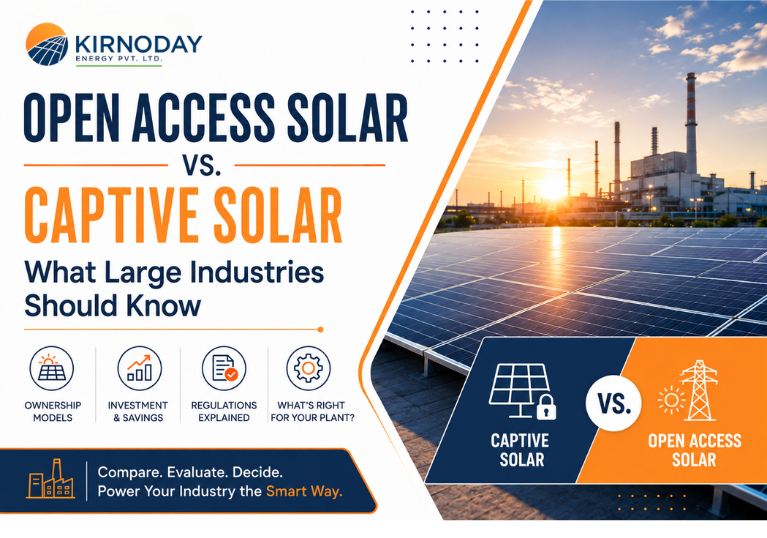
Open Access Solar vs. Captive Solar: What Large Industries Should Know
Once a manufacturing unit crosses a certain load threshold, rooftop solar alone often isn’t enough to meaningfully offset its power bill. That’s when two bigger models come into the conversation: Open Access solar and Captive solar. Both let large industries source power from a solar plant instead of the grid at commercial tariffs but they work very differently in terms of ownership, investment, and long-term savings.
If your plant’s monthly load runs into hundreds of kW or several MW, understanding this distinction matters before you commit capital.
What Is Captive Solar?
A captive solar plant is one your company owns, either fully or through a consortium, primarily to consume its own power. Under Indian electricity rules, a generating plant qualifies as ‘captive’ when the captive user(s) hold at least 26% equity and consume at least 51% of the electricity generated.
- Full or majority ownership:- the plant is built for your consumption, on your land or a group captive site.
- Long-term cost control:- power is generated at near cost-price, with no markup from a third-party developer.
- Regulatory exemptions:- captive plants are exempt from cross-subsidy surcharge in many states, improving savings.
- Capital intensive:- requires upfront investment (or equity participation) and asset management responsibility
What Is Open Access Solar?
Open Access allows a large consumer to buy power directly from a solar generator often located elsewhere in the state instead of the local distribution company (discom), by paying wheeling and transmission charges to use the grid infrastructure.
- No ownership required:- you sign a Power Purchase Agreement (PPA) and consume solar power without owning the plant.
- Lower upfront investment:- ideal for industries that want savings without capital lock-in.
- Flexible contracts:- PPAs are typically structured for a fixed term, often with a pre-agreed tariff.
- Additional charges apply:- wheeling, transmission, and cross-subsidy surcharge reduce net savings compared with captive.
Side-by-Side Comparison
Factor | Captive Solar | Open Access Solar |
Ownership | You (or your group) own equity | Third-party generator owns the plant |
Upfront Investment | High — capital or equity stake | Low to none — PPA-based |
Minimum Consumption Rule | 51% of generated power, 26% equity | Not applicable |
Surcharge Exemption | Often exempt from cross-subsidy surcharge | Subject to wheeling & surcharge |
Long-Term Savings | Higher, cost-price power for 25+ years | Moderate, tariff-linked to PPA term |
Best Suited For | Large loads, long investment horizon | Mid-to-large loads, capital-light approach |
Group Captive: A Middle Path
For industries that don’t want to fund an entire plant alone, group captive structures let multiple consumers jointly hold equity in a single solar plant, each drawing power in proportion to their stake while still meeting the 26% equity and 51% consumption norms. This has become a popular route for mid-sized industries in Gujarat looking to access captive-level savings without bearing the full project cost individually.
Which Model Should Your Industry Choose?
The right choice depends on three things: how much capital you’re willing to deploy, how long you plan to operate at your current site, and how large your annual power consumption is.
- Choose Captive (or Group Captive) :- if your load is large, stable, and you want maximum long-term savings with an ownership stake.
- Choose Open Access:- if you want solar savings quickly, without tying up capital or taking on asset ownership.
- Consider a hybrid path:-start with rooftop or Open Access for near-term savings, then move to captive as consumption and confidence grow.
How Kirnoday Energy Helps You Navigate This
Choosing between captive and open access involves regulatory filings, discom approvals, and structuring decisions that directly affect your savings for the next 25 years. Kirnoday Energy works with large industrial consumers across Gujarat & India to assess load profiles and recommend the ownership model that delivers the strongest return then executes it end-to-end.
- Load and consumption analysis to identify the right model for your plant.
- Feasibility studies for captive, group captive, and open access structures.
- Complete approvals and regulatory coordination with discoms.
- Tier-1 EPC execution with double warranty protection.
- Lifetime O&M cleaning, inspections, SCADA monitoring, and annual health checks.
Explore our Commercial & Industrial Solar Solutions built for large-load industries, or if your plant has limited land or roof space for a captive setup, see how Building-Integrated Photovoltaics (BIPV) can complement your energy strategy.
The Bottom Line
Captive solar rewards industries willing to invest for maximum long-term savings and control. Open Access solar offers a faster, lower-commitment route to lower power costs. Large industries increasingly evaluate both sometimes in combination as part of a broader energy strategy rather than a single one-time decision.
A proper feasibility study, based on your actual load and site conditions, is the only reliable way to know which model works best for your plant.
Or speak directly with our engineering team: +91 97277 14404 | info@kirnoday.in